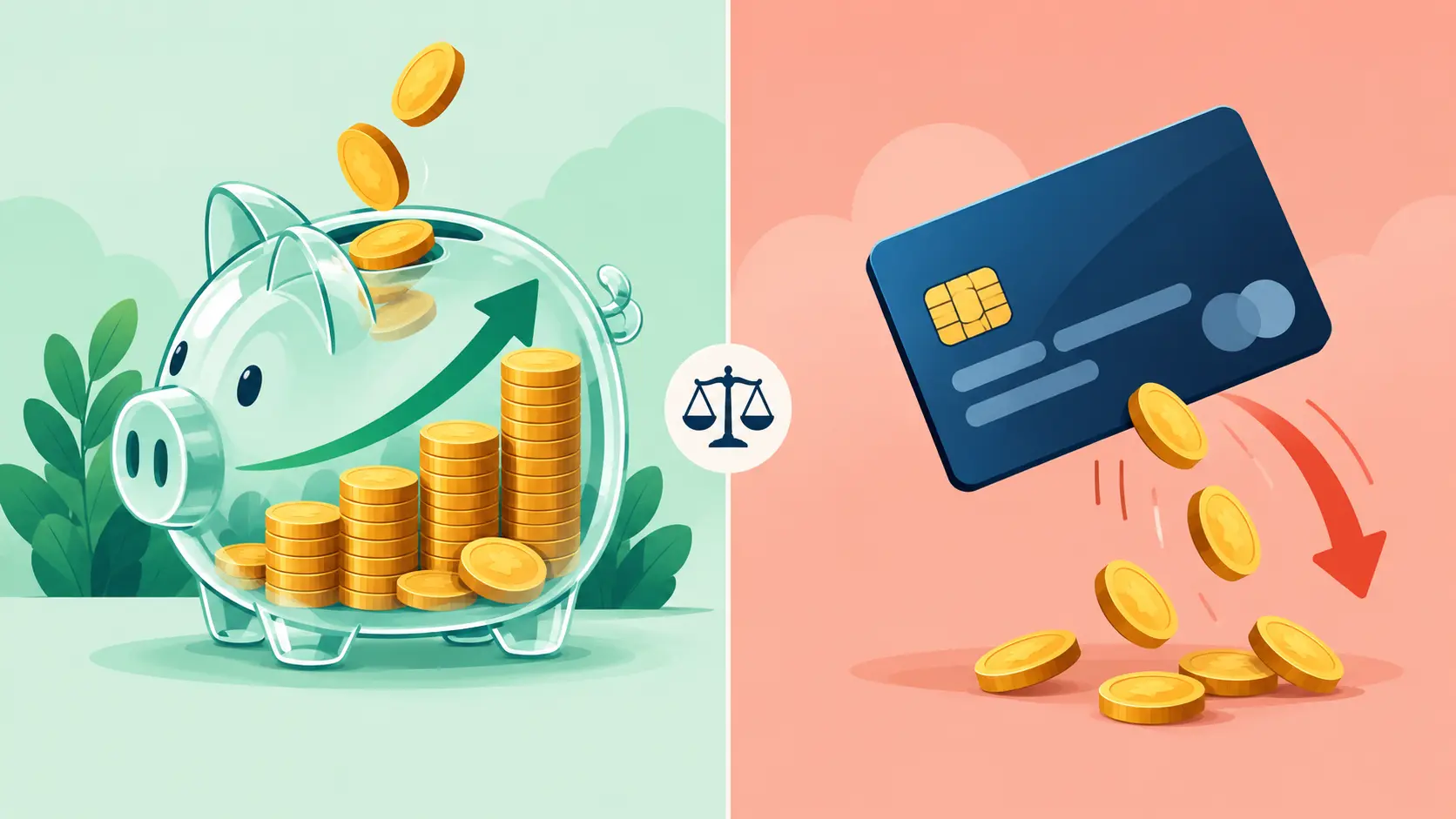
APY and APR both look like a yearly rate. They answer opposite questions: APY is what you earn. APR is what you pay.
Key takeaways
- APY (annual percentage yield) shows what savings accounts and CDs earn in a year, with compounding.
- APR (annual percentage rate) shows the yearly cost of credit cards and loans, without compounding.
- For savings, a higher APY wins. For borrowing, a lower APR wins.
- A 24% card APR really costs about 27% a year if you carry a balance.
APY vs APR at a Glance
APY
Annual percentage yield
- Used forSavings, money market, CDs
- CompoundingIncluded
- FeesNot included
- Required byTruth in Savings Act
▲ Higher is better
APR
Annual percentage rate
- Used forCredit cards, mortgages, loans
- CompoundingNot included
- FeesIncluded on mortgages
- Required byTruth in Lending Act
▼ Lower is better
What Is APY?
- The total interest you earn in one year on a deposit, as a percentage.
- It includes compounding, so you also earn interest on your interest.
- Banks and credit unions must show it before you open a deposit account, under the Truth in Savings Act (Regulation DD).
APY formula
APY = (1 + r ÷ n)n − 1
r = interest rate (decimal) · n = compounding periods per year
Example: $10,000 at 5.00%, daily
- Rate ÷ 3650.0137% a day
- APY5.13%
- Simple interest$500.00
- With daily compounding$512.67

What Is APR?
- The yearly cost of borrowing, as a percentage.
- Credit cards: the APR is the card’s yearly interest rate.
- Mortgages: the APR also includes points, broker fees, and other charges, so it’s usually higher than the interest rate (CFPB).
- No compounding is built in. If you carry a card balance, interest on interest pushes the real cost higher.
Daily cost of a 24% APR card: 24% ÷ 365 = about 0.066% a day. On a $5,000 balance, that’s roughly $3.29 in interest every day.
Turn any rate into APY
Enter a rate and compounding frequency. See the real yield and what it earns.
Why APY Is Higher Than the Rate
- Compounding is the whole difference.
- More frequent compounding = bigger gap.
- The gap is tiny on savings rates and large on credit card rates.
Stated rate vs. real yearly rate
When interest compounds daily
What this chart shows
- 4.50% savings rate earns 4.60% a year: only 0.10% extra.
- 5.00% savings rate earns 5.13% a year: about $13 more per $10,000.
- 24% card APR costs 27.11% a year: over 3% extra when you carry a balance.
- Bottom line: compounding barely helps savers but really hurts borrowers.
Which Number Should You Compare?

Savings account or CD
Compare APYIt already includes compounding. Also check: fixed or variable rate, minimum balance, fees.
Credit card
Compare APRCheck the purchase, balance transfer, and cash advance APRs, and when an intro rate ends.
Mortgage or loan
Compare APR + rateSame rate but higher APR = more fees. Lower APR usually costs less over the full term.
Pay your card in full by the due date and you generally won’t pay purchase interest at all, whatever the APR.
Common Mistakes to Avoid
- Comparing an APY to an APR. They measure different things: one is earnings, the other is cost.
- Assuming a savings rate is locked. Most savings rates are variable. CD rates are usually fixed for the term.
- Forgetting the intro period ends. A 0% intro APR jumps to the regular APR afterward.
- Ignoring taxes. Savings interest is generally taxable, so you keep less than the APY.
Frequently Asked Questions
Is APY the same as the interest rate?
No. APY includes compounding, so it’s equal to or higher than the interest rate. They match only when interest compounds once a year.
Why do banks show APY for savings but APR for loans?
Federal law. The Truth in Savings Act requires APY for deposit accounts, and the Truth in Lending Act requires APR for credit.
Is a higher APY always better?
Usually, for the same type of account. But some high APYs apply only up to a balance cap, need monthly activity, or are promos that drop later.
How do I convert APR to APY?
APY = (1 + APR ÷ n)n − 1, where n is compounding periods per year. Or use our APY calculator.
Run Your Own Numbers
Sources
- CFPB: Regulation DD §1030.4, Account disclosures
- eCFR: Regulation DD Appendix A, Annual Percentage Yield Calculation
- CFPB: Mortgage interest rate vs. APR
- CFPB: Credit card interest rate vs. APR
- CFPB: How credit card interest is calculated
This article is for educational purposes only and is not financial, tax, or legal advice. Rates and rules change, so confirm with your bank, lender, or a qualified professional before you decide.